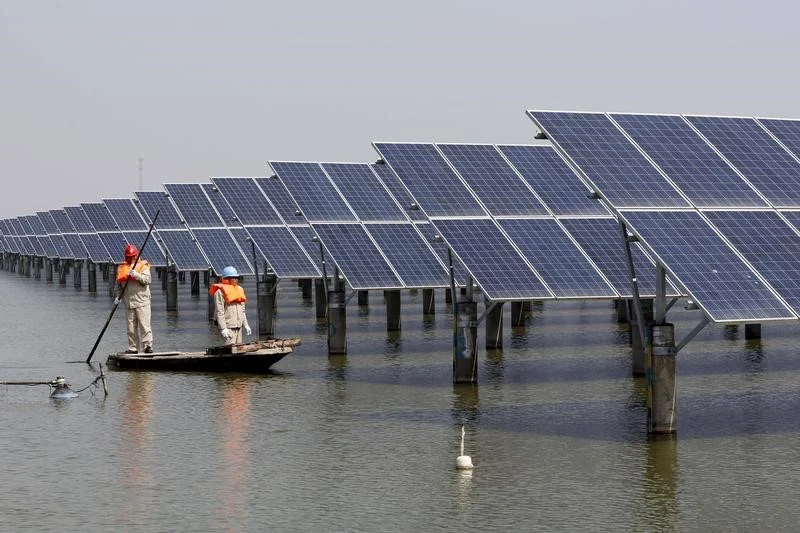
China's projected energy investment of $940 billion in 2026 is the largest of any country, and the most important part of that number may not be the headline total. It is the shift in where the money is going. According to the Global Energy Transition Report 2026, released by the China Enterprise Reform and Development Society and reported by CCTV, spending is moving toward electricity grids and the infrastructure needed to carry power from wind, solar and other renewable sources. That is the right priority, and investors should pay close attention to it.
The logic is straightforward. The report says China's installed renewable capacity reached 2.337 billion kilowatts at the end of 2025, equal to 60.1% of total installed generation capacity. Renewables supplied 38.3% of electricity output, and their growth was enough to cover the entire increase in national electricity consumption. Building generation is only half the job. Without transmission networks that can move that power to where it is needed, capacity sits idle. The International Energy Agency's expectation of roughly $140 billion in Chinese grid investment this year suggests that policymakers have understood this.
The report also points to tangible results. Coal-fired generation fell to 49.7% of electricity output in the first half of 2026, below 50% for the first time, and energy-related carbon dioxide emissions declined 0.5% in 2025. These are the kinds of figures that make the energy transition look like a managed process rather than a slogan. Still, a 0.5% fall in one year is a modest signal, and a single year of data does not establish a trend. Observers should watch whether the coal share keeps falling as demand grows.
There is also a broader industrial point. The report says China produces about 70% of the world's wind-power equipment and 80% of photovoltaic equipment. That dominance gives Chinese manufacturers and the companies that supply grid technology a large share of future demand, but it also concentrates supply chains in one country. Governments and companies elsewhere will need to weigh the benefits of low-cost equipment against the risks of depending on a single source.
My conclusion is that the grid spending should be treated as the central story of China's energy transition, not a footnote. Investment that connects renewable generation to users is what turns capacity figures into real emissions cuts. The next test is whether that spending keeps pace with the generation boom, and whether the coal decline proves durable.