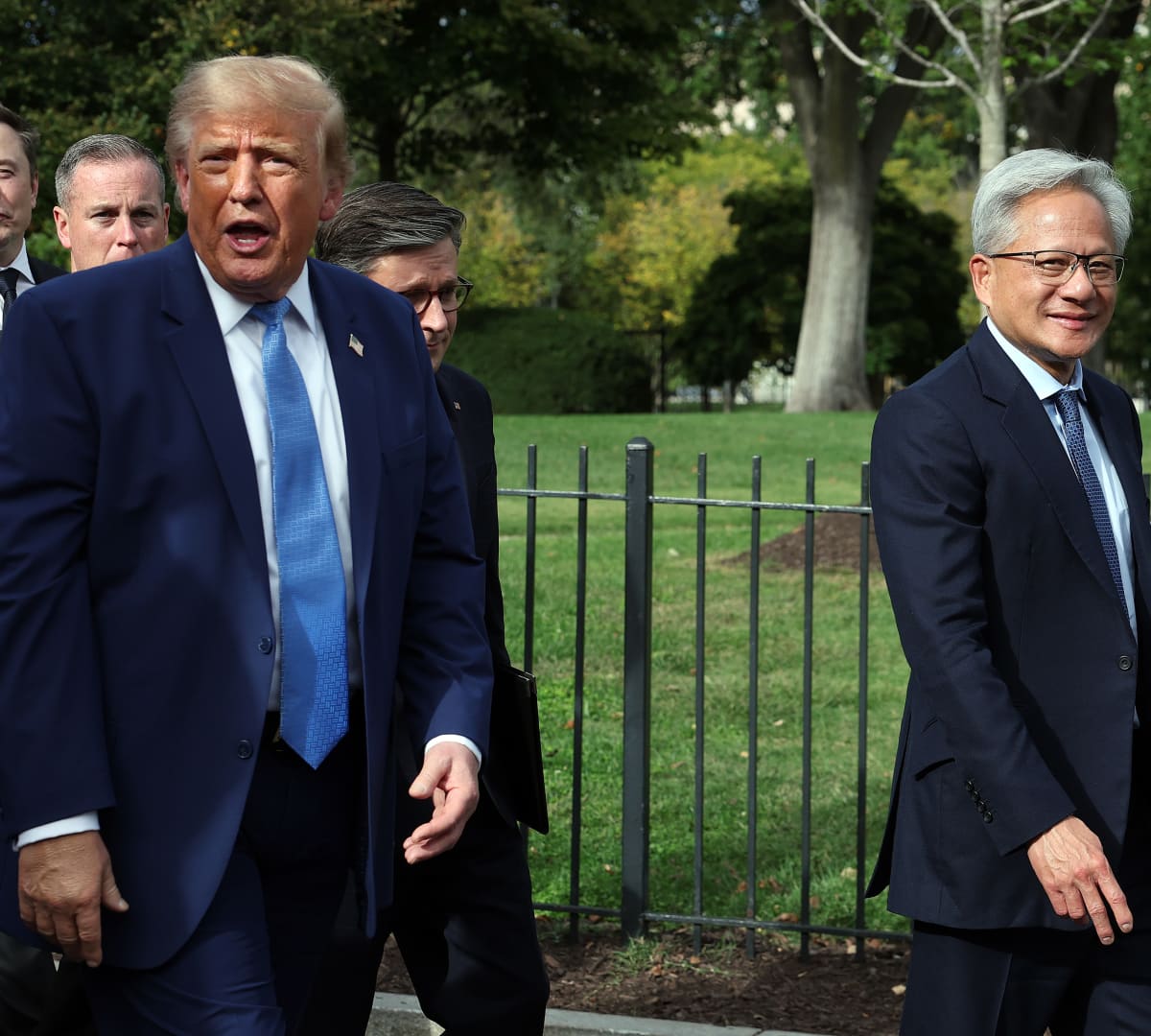
President Donald Trump has every reason to cheer Nvidia's rise, and that is exactly why the trading record in his accounts deserves scrutiny. According to a CNBC analysis of his financial disclosures, Trump's investment accounts have bought or sold Nvidia shares at least 103 times since he returned to the White House, in transactions worth a combined $27 million to $97.5 million. Nvidia became one of his three largest individual holdings by the end of last year.
The timing is what should trouble readers. A sale of $500,001 to $1 million came on May 18, the first Monday after Trump returned from a state visit to China with Jensen Huang. Five days earlier, The New York Times reported, Secretary of State Marco Rubio had briefed Trump on intelligence about Huang's relationship with a woman suspected of spying for China. Trump said on Monday, "I haven't heard that," and did not know whether she was a Chinese spy. Those two statements can both be true, but they do not settle the question of what the president knew when the trade happened.
The White House says independent advisors manage the portfolio without Trump's input, and the Trump Organization says the arrangement is designed to "avoid even the appearance of a conflict of interest." The disclosures, as the report notes, offer no evidence that Trump directed the trades or that his advisors had access to classified intelligence. That is a fair reading of the paperwork. But a blind trust that trades 21,000 times in a single year, compared with roughly 500 trades across Trump's entire first term, does little to reassure anyone that the arrangement is working as advertised.
The policy record makes the appearance problem harder to dismiss. Huang moved from a stranger at the inauguration to a regular at the White House, and the administration eased restrictions on Nvidia's chip sales to China even as intelligence officials briefed the president on Huang's associations. Nvidia's donations to Trump's ballroom and inaugural fund are a further reminder of how closely the company's interests and the administration's choices have intertwined.
What should happen next is straightforward. Congress and the relevant ethics and oversight bodies should ask for the advisors' written mandates, the timing of trade instructions, and whether any intelligence briefings reached the people making decisions in these accounts. Until those questions are answered, the president's assurance that he is shielded from his own portfolio is not enough, however much he touts the stock market.